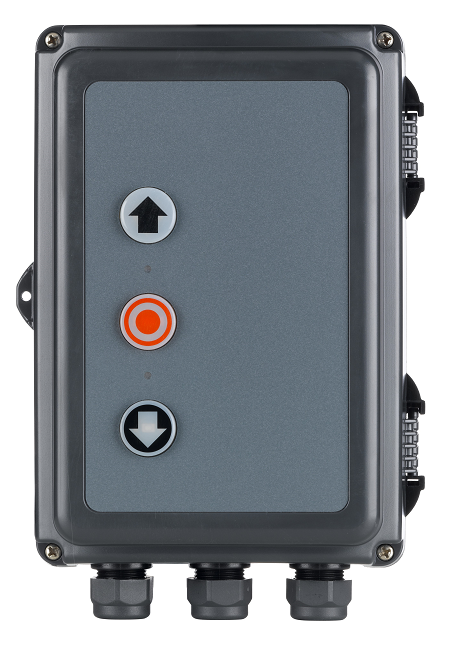
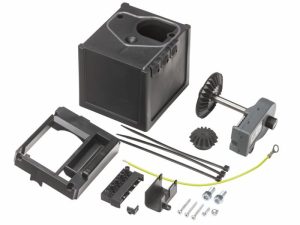
A compact enclosure system for control electronics and expansion modules
It is not a controller itself, but a protective and mounting enclosure used with:
- Control units (e.g., CS-series)
- Expansion modules (MS-Bus modules like EM 172, EM 185)
- Interface electronics
Core Purpose
The Mini Housing is designed to:
- Protect electronics (dust, moisture, impact)
- Provide compact installation near the operator
- Enable modular expansion of control systems
Marantec control units are designed to be flexible and can be installed remotely thanks to compact housings
Construction & Design
Physical Design
- Compact plastic or composite enclosure
- Wall-mounted or DIN rail (top-hat rail) compatible
- Cable entry points for field wiring
- Hinged or removable cover
Mounting
- Direct mounting on:
- Wall
- Operator frame
- Control cabinet panel
Many modules come pre-assembled inside the mini housing for quick installation
Protection & Environmental Specs
Typical values (from Marantec mini housing modules):
- Protection rating: IP65 (weather resistant)
- Temperature range: -20°C to +60°C
- Suitable for:
- Indoor industrial environments
- Outdoor sheltered installations
Internal Components (Typical Use)
The Mini Housing is commonly used to house:
Expansion Modules (MS-Bus)
Example:
- EM 172 (I/O module)
- EM 185 (light grid interface)
Typical Features inside housing:
- 4 programmable inputs
- 4 relay outputs (potential-free)
- LED diagnostics
- Plug-in connections
Example module specs include 4 inputs, 4 relay outputs, and LED diagnostics
Interface / Sensor Modules
- Light curtain (OSE) interfaces
- Safety edge processing
- Additional sensor logic
Supports OSE light grids and safety devices via integrated logic
Communication Interfaces
- MS-Bus (Marantec system bus)
- RJ14 / pluggable connectors
- Daisy-chain capability
System Integration
Works With:
- CS 320 control unit
- CS 265 control unit
- DF / WF / MDF operator systems
Function in System
The Mini Housing acts as:
A decentralized control extension node
It allows:
- Expanding I/O capacity
- Moving electronics closer to sensors
- Reducing wiring complexity
Electrical Characteristics (Typical for housed modules)
- Operating voltage: 24V DC
- Low-power electronics
- Bus-powered (via MS-Bus)
Example: modules operate on 24V DC control voltage
Functional Role in “Position Box” Context
When referred to as a “Mini Housing Position Box”, it usually means:
A small auxiliary control enclosure used alongside:
- MEC (mechanical limit systems)
- AWG (encoder systems)
- DTDC / DTWC (digital systems)
Instead of a full CS320 cabinet, this is:
- Smaller
- Modular
- Task-specific
Mini Housing vs Full Control Panel (CS320)
| Feature |
Mini Housing |
Full Control Panel (CS320) |
| Size |
Compact |
Large enclosure |
| Function |
Expansion / interface |
Full control logic |
| Mounting |
Flexible, local |
Fixed installation |
| I/O capacity |
Limited per module |
High |
| Use case |
Add-ons, sensors |
Main system control |
Key Advantages
- Compact and space-saving
- Modular expansion capability
- Easy installation (pre-assembled modules)
- Weather-resistant (IP65)
- Reduces wiring runs
Limitations
- Not a standalone controller
- Limited I/O per unit
- Requires main control unit (CS320/CS265)
(The Company reserves the right to amend product specifications and information without notice.)